Frustration Cycle Explained: How to Release Judgment of Frustration and Get Unstuck Using Dr. Gordon Neufeld's Model and Eight Somatic Practices
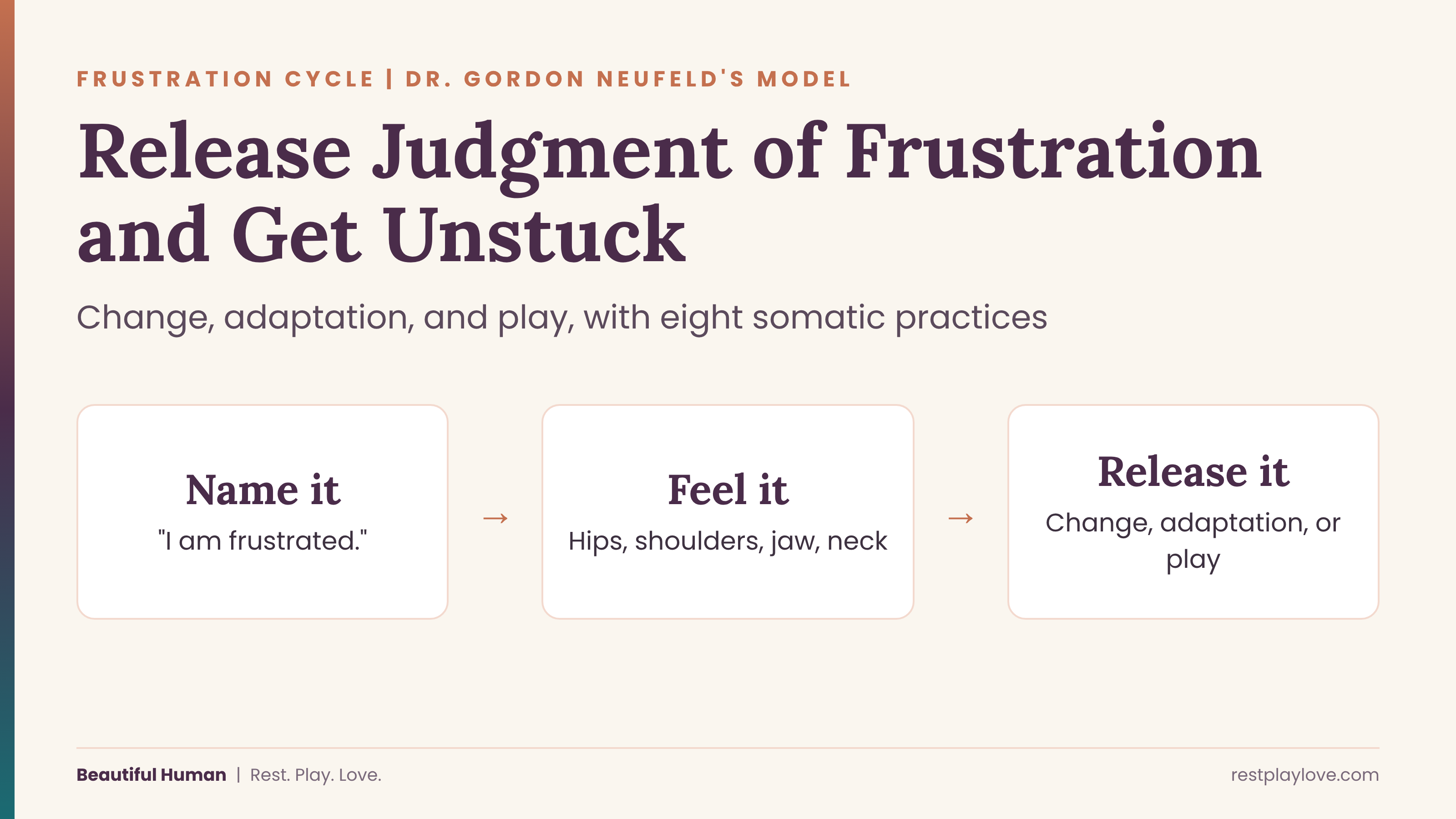
A Somatic, Attachment-Informed Guide to Irritability, Anger, Body Tension, and Emotional Release Through Change, Adaptation, and Play
Many people carry two layers of frustration at once. Layer one arises from a situation, a relationship, or a pattern that is not working. Layer two arrives within seconds and sounds like "I should be calmer than this," "I am too sensitive," or "why can I not let this go." Layer two is judgment of frustration, and it adds more frustration to a nervous system that has not yet completed its first job, which keeps many capable, self-aware people in a cycle that intensifies with repetition.
This post follows a model by Dr. Gordon Neufeld, one of the most brilliant and highly lauded attachment theorists, who spent decades working with frustrated children, adolescents, and adults and mapped how frustration moves through our nervous system when conditions support it and when they do not. His model describes frustration as a hardworking emotion with a clear purpose and three possible outcomes: change, adaptation, or attack. You will see where judgment enters that sequence, why judgment interrupts it, and how eight small somatic practices release frustration early so your system can complete what it started.
As a somatic nervous system coach and mindfulness researcher trained at Polyvagal Institute, I bring Neufeld's emotional framework together with bottom-up, body-based tools, which means working with sensation, breath, voice, movement, and play as direct routes into your physiology and achieving the desired changes.
Educational Notice: This material is educational and does not replace personalized medical, psychological, or clinical advice. If you have a history of trauma activation, dissociation, or a medical condition affecting breathing or movement, approach these practices gradually and with support from a trauma-informed provider.
Why Frustration Exists: A First-Responder Emotion That Pushes for Change
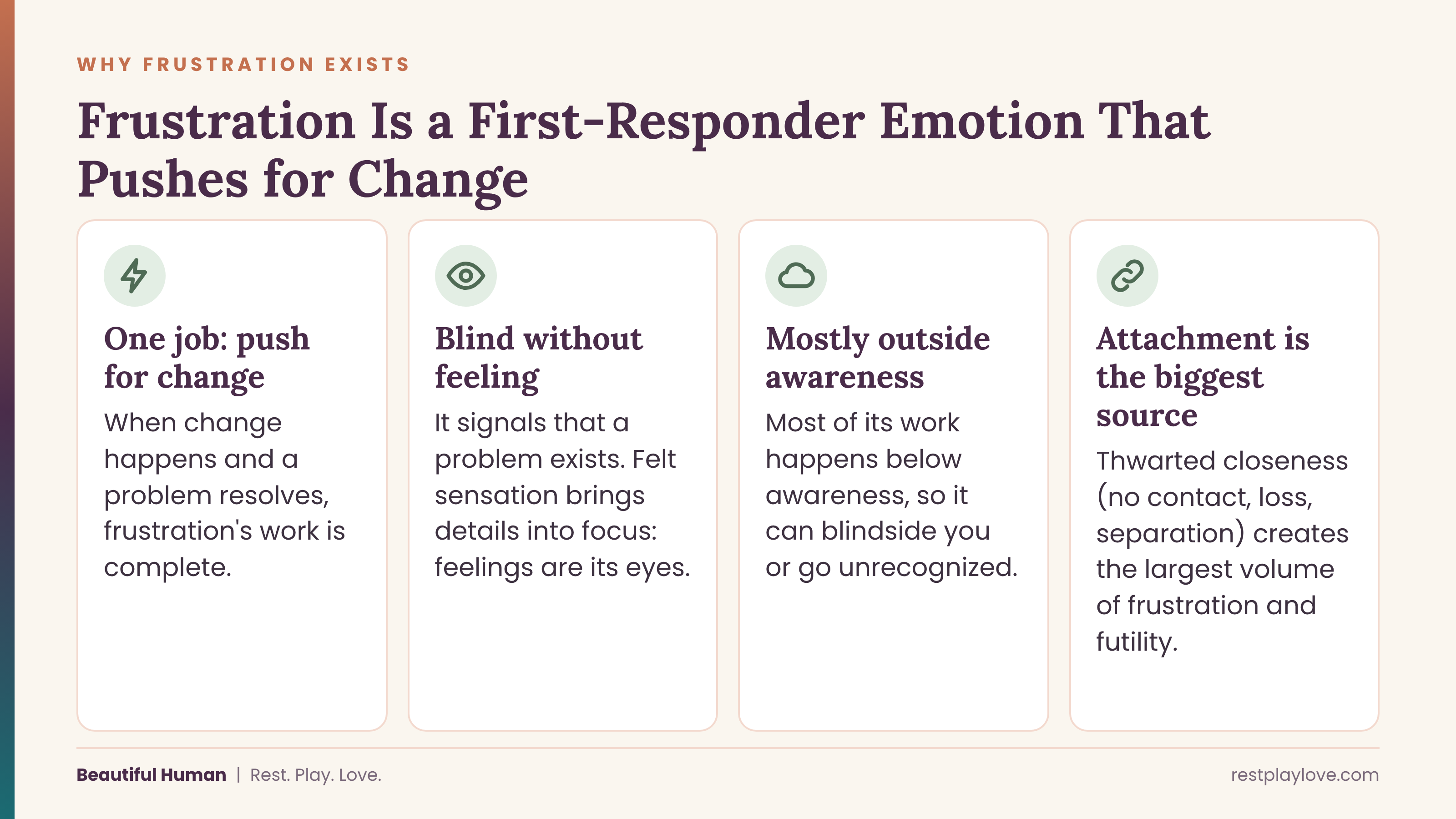
Frustration is a primal emotion, which means it operates as a first responder in your brain's response to incoming information. It holds an early position in that line of defense and scans constantly for any condition that is not working. Neufeld's defines frustration as signaling that a situation, relationship, or pattern is not working and pushes forcefully for change or adaptation if change is not possible (as in the case of loss.) Emotion carries a root meaning of movement, and frustration supplies that movement.
Frustration't only job is to bring about change. When change happens and a problem resolves, frustration's work is complete and its story ends well. Most of its work occurs below awareness, which explains why irritability can arrive as a surprise, why you may notice a clenched jaw before you notice a feeling, and why frustration can go unrecognized for hours or days.
Frustration also functions as a blind signal. It reports that a problem exists and carries few details about what that problem is or why it's important. Details about the underlying problem come into focus when frustration is felt in your body, which is why Neufeld describes feelings as the eyes of frustration. Felt frustration becomes specific information you can act upon: this meeting format drains me, this friend has gone quiet, this deadline conflicts with a value I hold. Unfelt frustration tends to attach to a nearby, nebulous explanation, and a thought like "my coworker causes this" can substitute for felt information. Neufeld calls this cognitive backfill, and he observes that change built on a backfilled explanation often fails to resolve your original signal because it's not derived from a felt sense of the frustration that would allow you to connect to its root cause.
Secure attachment, which all mammals are wired for in order to survive, generates a large share of frustration. Your drive for closeness and connection ranks as a primary human need, so thwarted proximity (no contact, loss, separation, a loved one who stays out of reach) creates a larger volume of both frustration and futility than any other source, since you cannot control whether another person holds on to you. Many adults carry frustration that traces back to relationship events they cannot change, and Neufeld's model has developed a specific plan for those circumstances that are outside of our control.
How Frustration Shows Up in Your Behavior and Your Body
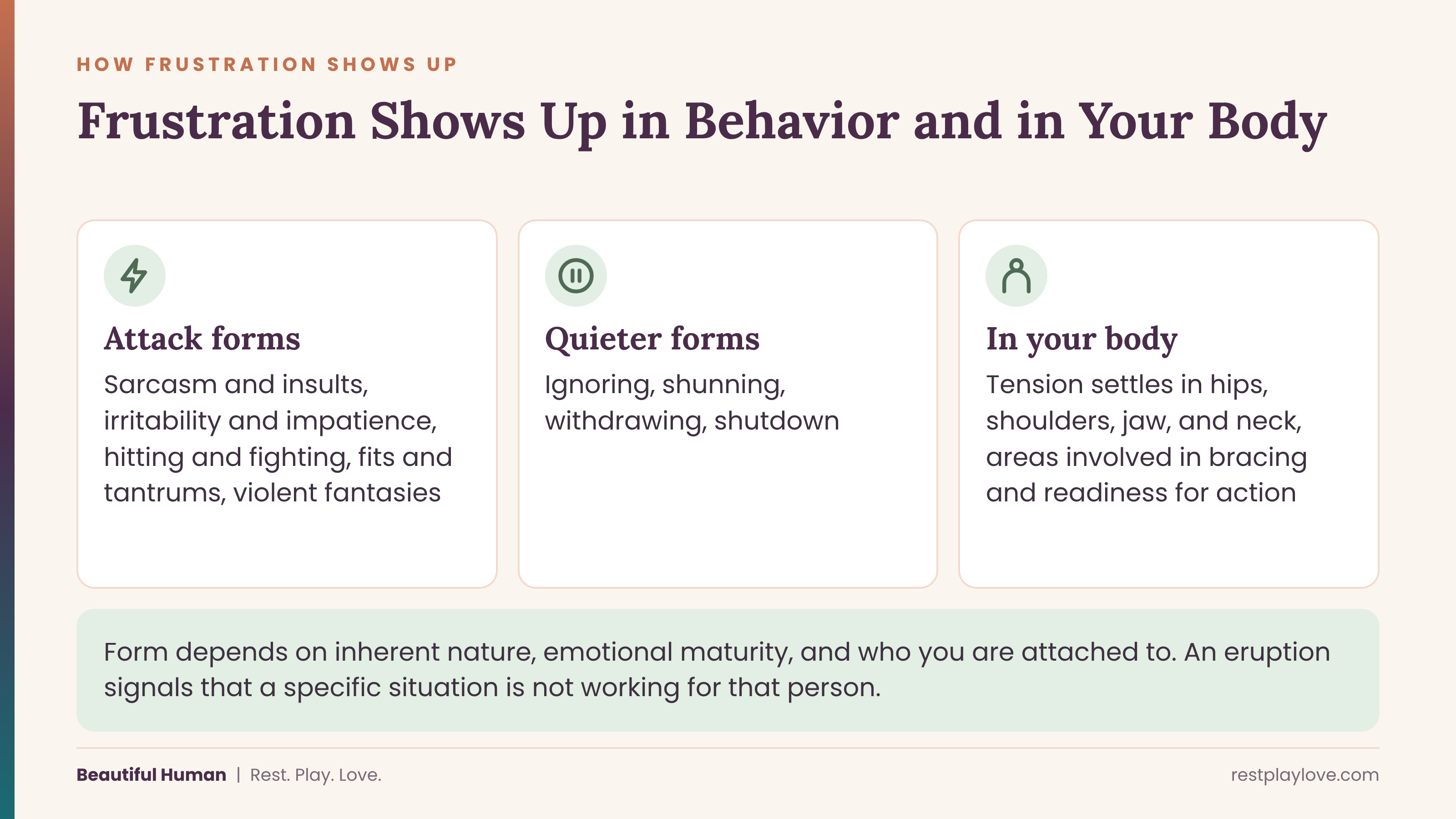
Frustration takes different forms depending on a person's inherent nature, level of emotional maturity - which is related to their early development, and who they are attached to. When frustration cannot produce change, it turns toward attack, and attack includes sarcasm and insults, irritability and impatience, hitting and fighting, fits and tantrums, and violent fantasies. A quieter set of forms includes ignoring, shunning, withdrawing, and shutdown. Many people who consider themselves calm express frustration in this quieter category, and it often goes unnamed because it looks like tiredness, boredom, or a decision to keep peace.
In your body, frustration settles in your hips, shoulders, jaw, and neck, which are areas involved in bracing and readiness for action. Mobilized energy (adrenaline, cortisol, motor preparation) is designed to discharge through movement. When your prefrontal cortex overrides that discharge reflex, energy stays bound in your neuromuscular system, and tight muscles keep reporting threat to your brainstem after the original frustration has passed. A tense jaw at night can carry frustration from a morning conversation.
An eruption in a child, a student, or an adult signals that a specific situation is not working for that person. Reading an eruption as frustration changes how you respond to others and to yourself, and Neufeld describes this reframe, from misbehavior to frustration, as phenomenally transformative.
Neufeld's Traffic Circle: Change, Adaptation, and Attack
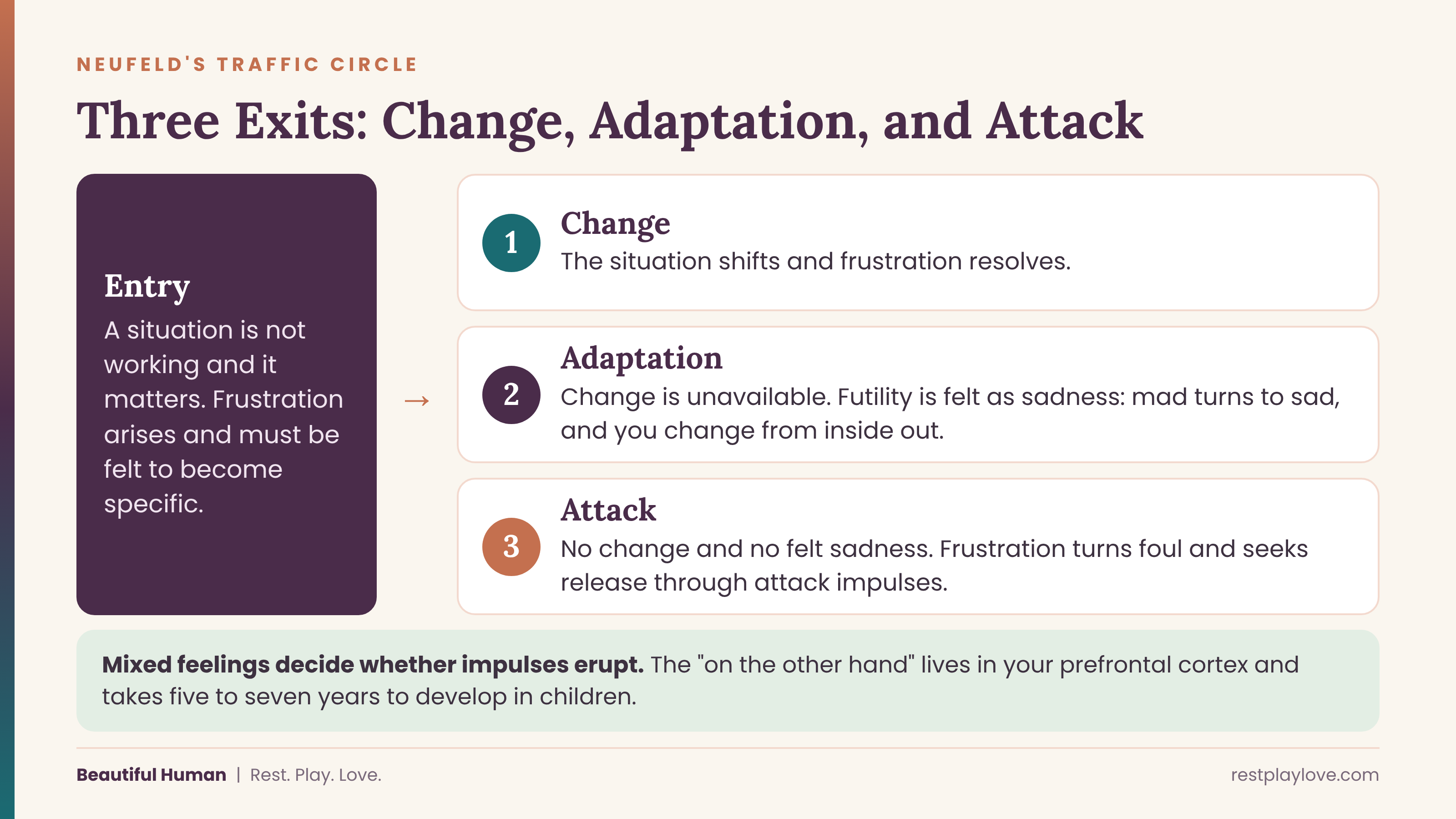
Neufeld describes frustration as a traffic circle with three exits. Frustration enters when a situation is not working and it's important to you. It must be felt to become specific, and from that point your system takes one of three exits.
Exit 1, Change. When a situation can shift and you take action that shifts it, frustration resolves. This is why frustration exists: to notice what is not working and to motivate action that fixes it.
Exit 2, Adaptation. Many circumstances cannot be changed, including other people's decisions, your past, loss, getting your way every time, holding on to good experiences, and your own mortality. For these, frustration turns into felt sadness. Mad turns to sad, and tantrums or screaming fits turn to tears. Feeling futility lets deep internal change proceed, so frustration either changes your circumstances or changes you. Futility has to be felt in your body for precise adaptation to proceed, and understanding it intellectually lacks the precision held in our felt sense and tends to leave adaptation incomplete.
Exit 3, Attack. When frustration can neither produce change nor turn into felt sadness, it turns foul and seeks release through impulses to attack. Mixed feelings decide whether those impulses erupt. Mixed feelings are your internal "on the other hand," which lets you feel an urge to lash out and hold back because you do not want to hurt someone you love or get into trouble. This capacity lives in your prefrontal cortex and takes roughly five to seven years to come online in children, under conducive conditions of optimal development undisrupted by attachment trauma. Many adults are still building it, since chronic stress, unsafe relationships, and a lack of safe places to feel and express feelings can leave this capacity underdeveloped across a lifetime.
How Judgment of Frustration Keeps You Stuck in Frustration Cycles
Neufeld names three ingredients shared by each instance of attack, which he calls a perfect emotional storm. 1) You are highly frustrated, because a situation is not working and it's important to you. 2) You are slow to sadness, because futility is encountered and intellectualized rather than felt. 3) You lack mixed feelings, because no tempering "on the other hand" is available in that moment. Judgment of frustration strengthens each of these three already undermining ingredients to resolving the original frustration.
Judgment functions as a consequence you deliver to yourself. Neufeld observes that consequences meant to teach a lesson add frustration without helping a person feel futility, and so they work against adaptation. "I should be over this by now" is an internal consequence of this kind. It adds frustration, and it leaves no room for the sadness underneath to be fully felt.
Judgment replaces felt information with explanation. Statements like "I am overreacting" or "I am a difficult person" are cognitive backfill. They arrive quickly, they feel like insight, and they keep your attention in thought, where frustration cannot become specific. They are an adaptive attempt to escape our own projections of future abandonment by others for our frustration and the behaviors that come with it.
Judgment separates you from your own experience. Neufeld points out that an eruption followed by being sent away or shut out deepens separation, and separation fuels frustration. When you push your own frustration away, by suppressing it, shaming it, or distracting from it, you create a similar separation internally. I see a close parallel here: attempts to get rid of frustration reproduce a disconnection that generates more of it.
Judgment inhibits feeling. Feelings become defensively inhibited when they seem too vulnerable to bear, and ongoing inhibition of feelings prepares conditions for attack. A message of "this feeling is unacceptable" raises that vulnerability and lowers your access to sadness and to mixed feelings.
Judgment adds body tension. Judgment is a top-down override, and top-down override of discharge leaves mobilized energy stored in your hips, shoulders, jaw, and neck. Tight muscles continue to report threat, which supplies fresh input for frustration.
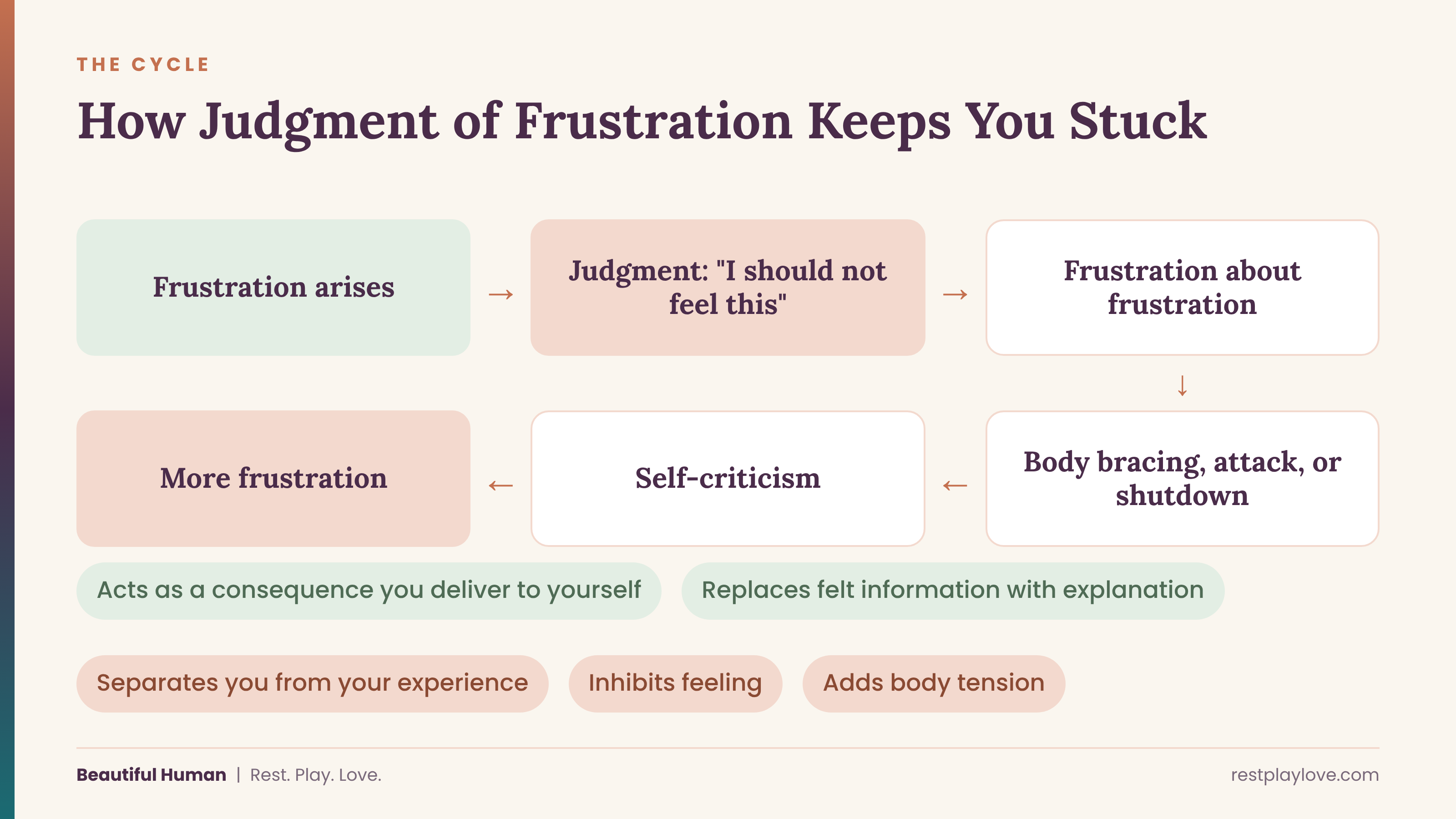
Neufeld describes people in this state as doubly frustrated, a frustration that has been frustrated. In practice, this sequence looks like:
Frustration arises → Judgment ("I should not feel this") → Frustration about frustration → Body bracing, attack, or shutdown → Self-criticism → More frustration
Each step in this sequence is physiological as well as mental, which explains why insight alone rarely ends it. Each step also offers a point of release.
Five Steps to Release Judgment of Frustration
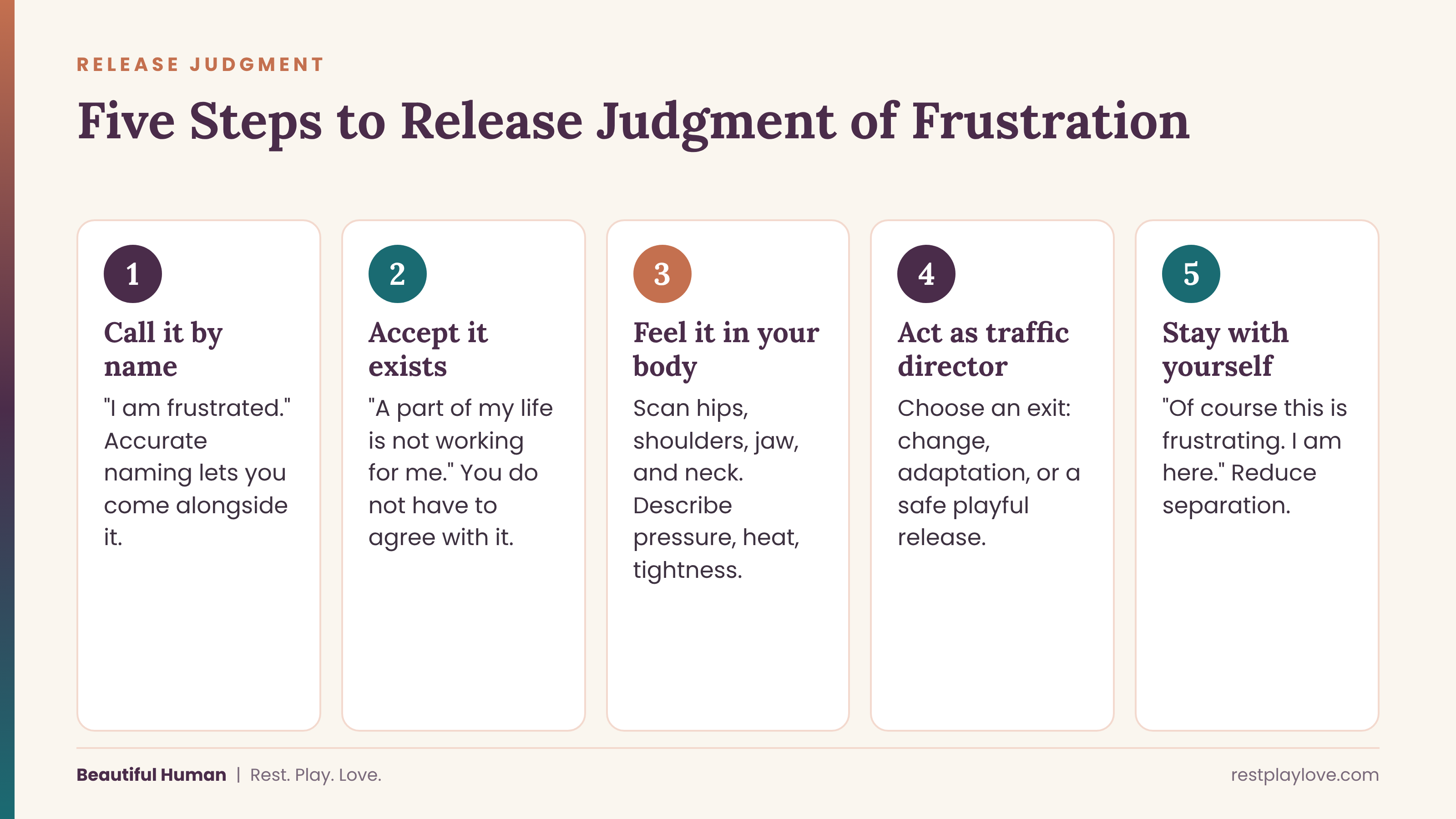
These five steps apply Neufeld's guidance on cultivating a healthy relationship with frustration. Practice them in order, in private, with a few breaths between steps.
Step 1: Call it by name and using presence language. Say "Something in me feels frustrated" out loud or silently, in place of labels such as anger, meanness, overreacting, or misbehavior. Accurate and dis-identified naming lets you come alongside frustration, and research on affect labeling shows that putting a precise word to an emotion reduces amygdala activity. Naming also begins making a diffuse signal specific.
Step 2: Accept that frustration exists. Acceptance is not agreeing. You do not have to agree with it, like it, or act on it. You only need to give it space to work. Try saying: "A part of my life is not working for me, and the frustration I feel is letting me know that this is happening." This sentence grants frustration its purpose without requiring any particular response from you.
Step 3: Feel it in your body. Feelings are frustration's eyes, so locate it. Scan your hips, shoulders, jaw, and neck, or maybe even your solar plexus area, and describe sensation in plain physical terms: pressure, heat, tightness, a pulling direction, a pushing direction, upward or downward movement, contracting or expanding. Stay with your felt sense of frustration for a few breaths. This is where frustration becomes specific, and where specificity replaces backfilled explanation, allowing to get in touch with the root of your feelings of frustration.
Step 4: Act as your own traffic director. Ask which exit fits. If change is possible, identify your smallest available action to resolve frustration, such as a message to send, a boundary to name, or a request to make. If change is unavailable, frustration is meeting futility, and your task becomes allowing sadness. Mad turns to sad when you let your chest, throat, and eyes do what they are built to do. If the energy of frustration is still too high and neither change nor sadness is reachable yet, take your frustration into a safe release, such as one of eight practices later in this post. Safe release keeps energy from turning on you or on someone you love while you find your exit when it becomes available, avoiding the third exit of 'attack', which over time only builds more frustration and judgment.
Step 5: Stay with yourself. Neufeld's guidance on reducing separation applies to your inner life as well. After an eruption or a hard moment, avoid sending yourself away with self-criticism. Speak to yourself as you would to a loved one who is frustrated: "Of course this is frustrating. No wonder! I am here with you. And I'll be right here for as long as you want me to be." Many people find this step hardest, and it responds well to practice, since your nervous system learns safety through repeated experience of being met.
Create Safe Conditions for Frustration to Move Through You and Through People You Love
Adaptation depends on sadness, and sadness is a tender emotion. Most people feel safe enough to cry only with someone they are attached to, so a safe relationship and a safe place to cry form a core part of how frustration resolves. Without a safe place to cry, frustration has no route to adaptation through the acceptance of the futility of the circumstances.
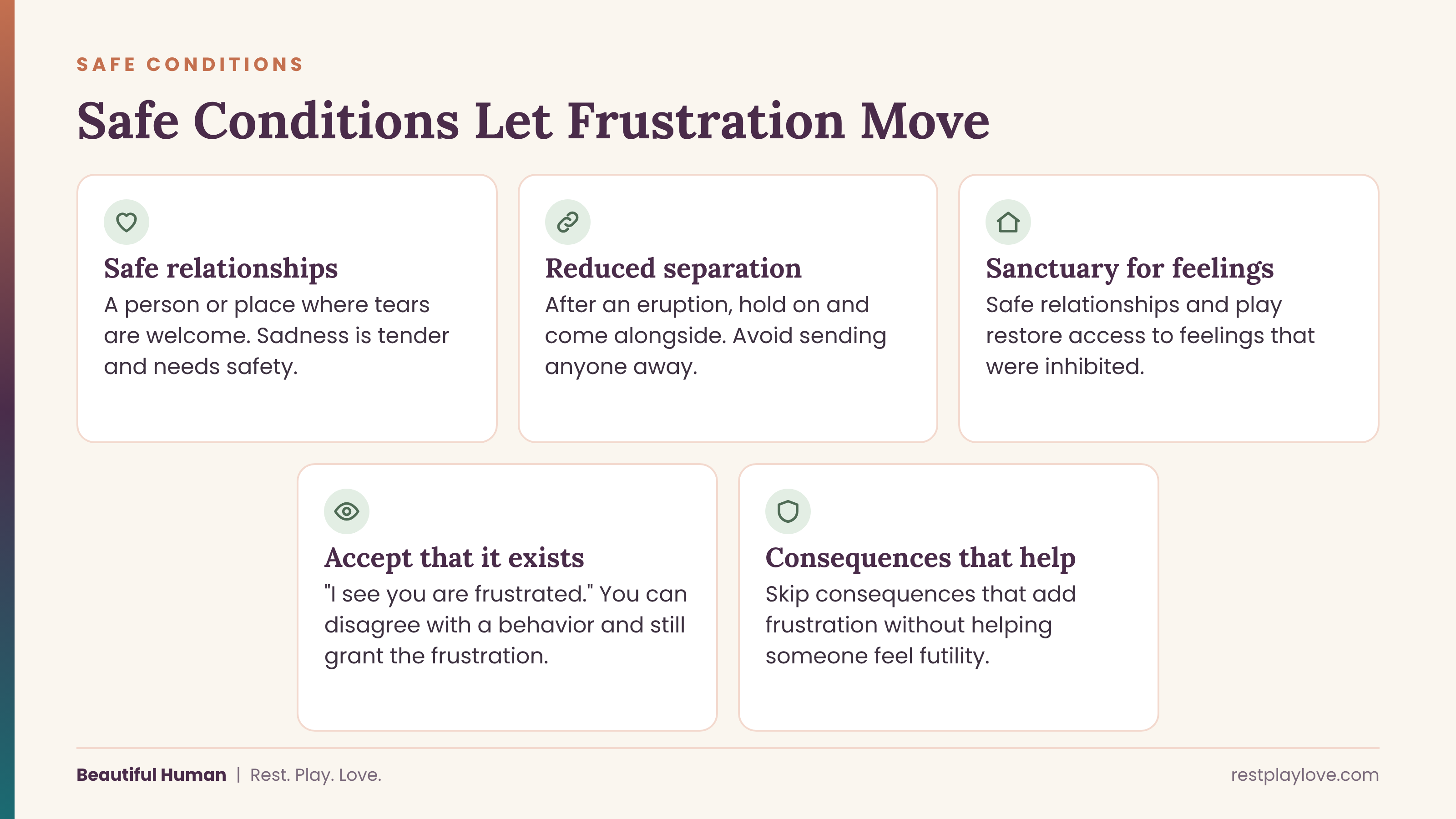
These conditions support healthy processing for you, your children, your students, and your partners:
Safe relationships and a safe place to cry. Identify one person, or one private place, where tears are welcome. Many adults have had no experience of this, and building it deliberately constitutes emotional work.
Reduced separation. After an eruption, avoid sending a person away, pushing them off, or shutting them out. Hold on and come alongside. This guidance applies to you as well.
Sanctuary for feelings. Feelings become defensively inhibited when they feel too vulnerable to bear, and safe relationships and play restore access to them.
Accepting that frustration exists. You can disagree with a behavior and still grant that frustration is present. A sentence such as "I see you are feeling frustrated" lets you stand with that fact that a situation is not working for someone you love, which is itself a form of care. You cannot make every situation work for another person, and standing alongside them in that fact unites you where fighting it would divide you.
Consequences that help. Skip consequences that add frustration without helping a person feel the underlying futility of the circumstances they feel frustrated about. Connection, naming, and play serve adaptation better than isolation.
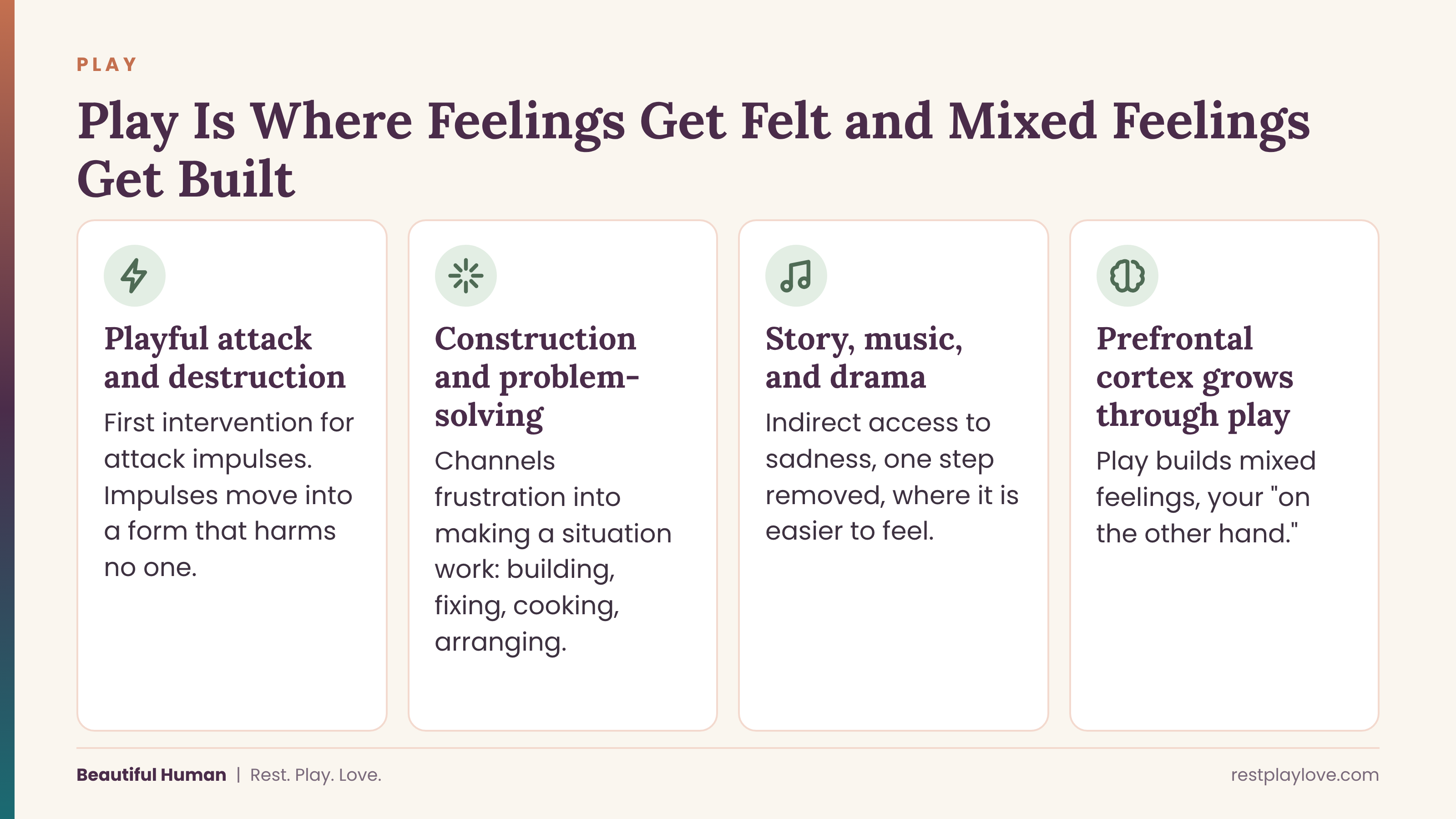
Play: Where Feelings Get Felt and Mixed Feelings Get Built
Play is a second sanctuary for feelings, alongside safe relationships. Emotion is most easily felt in play, and mixed feelings get built there, since your prefrontal cortex develops through play.
Playful attack and playful destruction are Neufeld's first intervention for attack impulses. Play takes an attack impulse into a form that harms no one and requires no willpower to remove it. Construction and problem-solving play channels frustration into making a situation work, which is why building, fixing, cooking, and arranging can settle frustration that talking has not. Story, music, and drama give indirect access to sadness, one step removed, where it is easier to feel and can even feel sweet. Neufeld notes that ancient Greeks made room for attack in their games, joined frustration to sadness in their tragedies, and treated mastery of music as essential for children, and he describes play as a crucible of civilization.
For adults, this can include a song that carries sadness, a film that brings tears, a drum, a pile of old paper to tear, a project to build, or a game with people you trust. Treat these as practice for your nervous system, and give them enough time to see results.
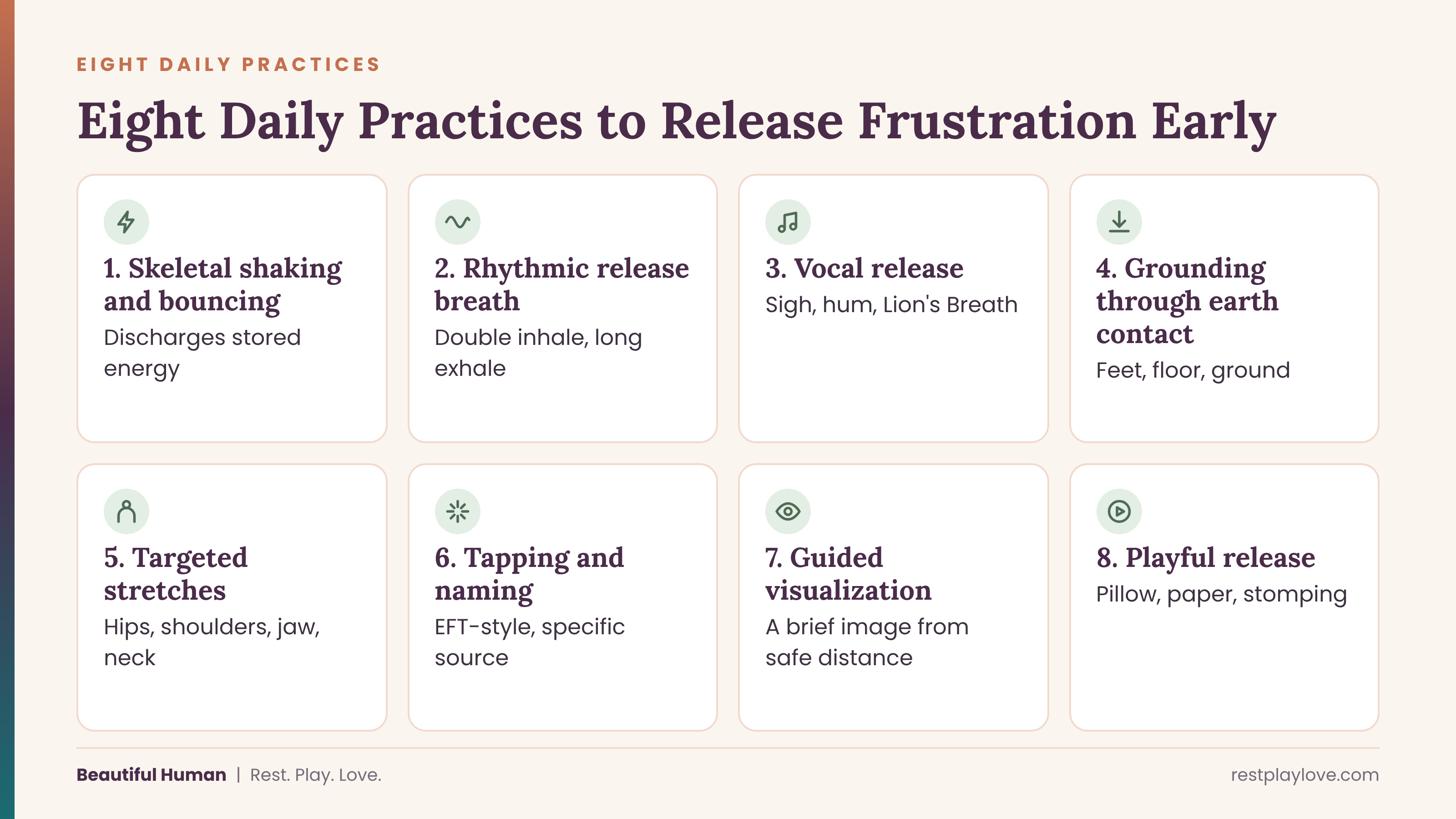
Eight Daily Practices to Release Frustration Early
Each practice below includes a mechanism, a step-by-step guide, and somatic markers to look for. Frustration released early, while energy is still mobilized and before judgment has layered on, completes more easily and requires less effort.
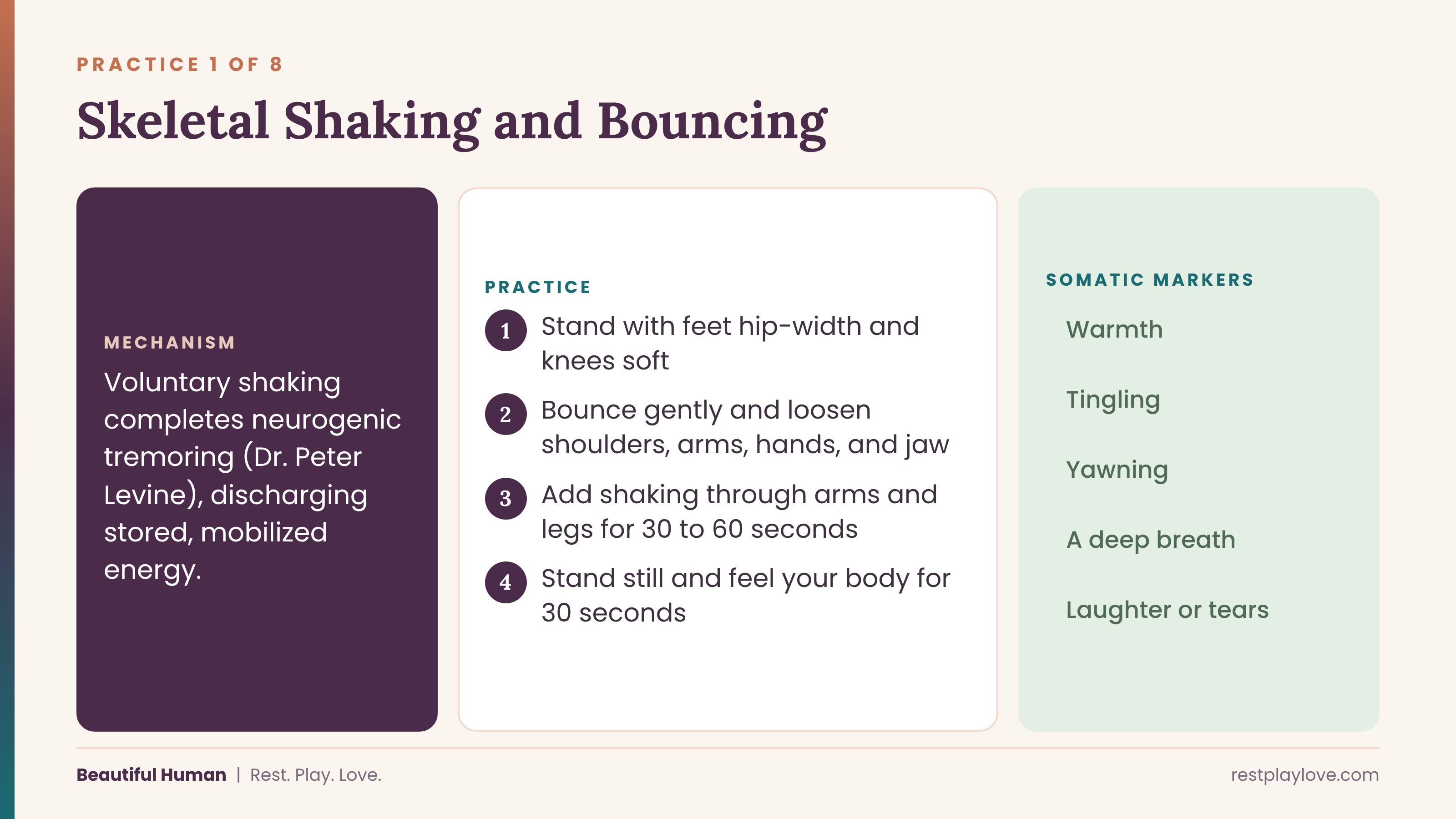
1. Skeletal Shaking and Bouncing
Mechanism: Loose, rhythmic shaking supports completion of neurogenic tremoring, which Dr. Peter Levine describes as a mammalian process that discharges stored, mobilized energy after activation. Voluntary shaking gives your nervous system that completion pathway when your prefrontal cortex has overridden spontaneous discharge.
Practice: Stand with feet hip-width apart and knees soft. Begin bouncing gently, letting your heels touch down and your knees absorb the bouncing movement. Allow your shoulders, arms, hands, and jaw to loosen. Add shaking through your arms and legs and continue for 30 to 60 seconds. Stop, stand still, and feel your body for 30 seconds.
Somatic Markers: Warmth, tingling, a faster heartbeat that settles, a spontaneous deep breath, yawning, laughter, or tears.
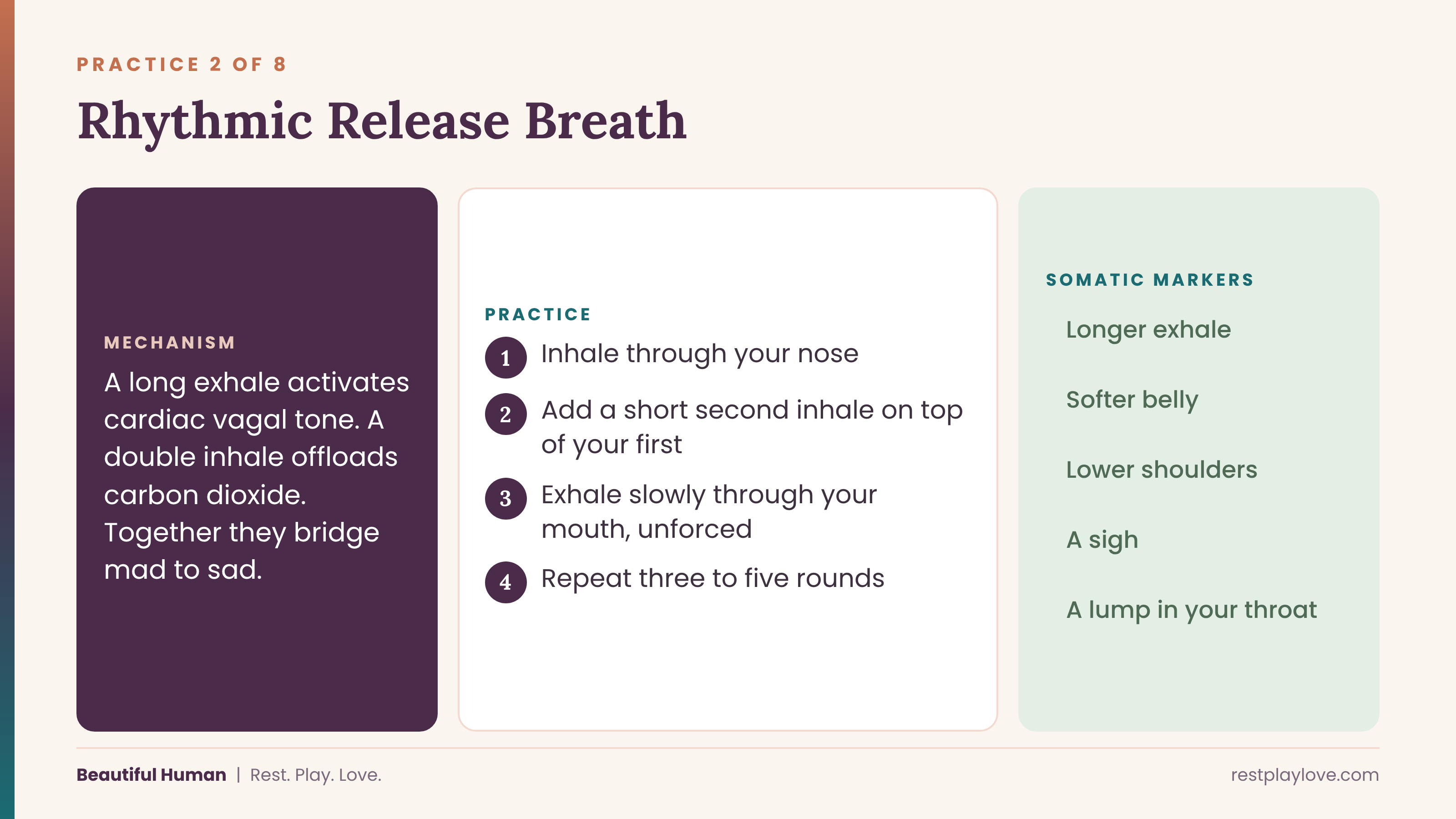
2. Rhythmic Release Breath
Mechanism: A physiological sigh consists of a double inhale followed by a long, unforced exhale. Your exhale activates cardiac vagal tone, slowing your heart rate, and your double inhale offloads carbon dioxide, which brings a faster drop in arousal. In a 2023 study published in Cell Reports Medicine, five minutes a day of cyclic sighing improved mood and lowered respiratory rate more than mindfulness meditation. In this context, release breath bridges mad to sad by lowering arousal enough for feeling to surface allowing futility to be felt.
Practice: Inhale through your nose, add a short second inhale on top of your first, then exhale slowly through your mouth for as long as feels unforced. Repeat three to five rounds.
Somatic Markers: A longer exhale, a softer belly, a drop in shoulder height, a sigh, or a lump in your throat.
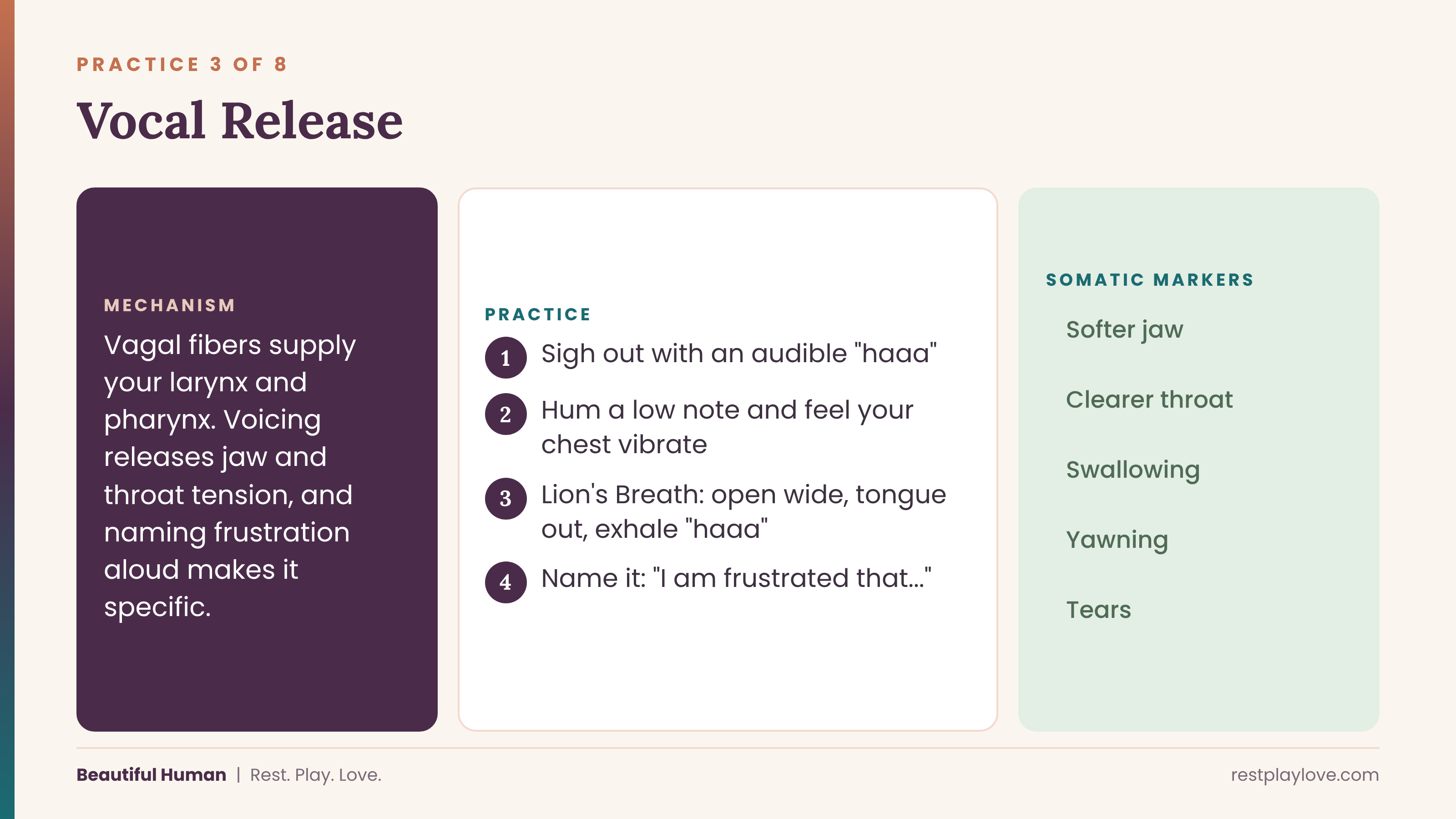
3. Vocal Release
Mechanism: Vagal fibers travel to your larynx and pharynx, so sighing, humming, and Lion's Breath stimulate vagal fibers in your throat and chest. Voicing also releases jaw and throat tension, and naming frustration out loud makes it specific.
Practice: Sigh out with an audible "haaa." Hum a low note and feel vibration in your chest and face. For Lion's Breath, inhale through your nose, open your mouth wide, extend your tongue toward your chin, widen your eyes, and exhale with a strong "haaa." Add a spoken sentence using presence language such as "Something in me is feeling frustrated that this deadline keeps moving." (or whatever else is activating feelings of frustration.) Practice three rounds in a private space.
Somatic Markers: A softer jaw, a clearer throat, swallowing, yawning, a lighter chest, or tears.
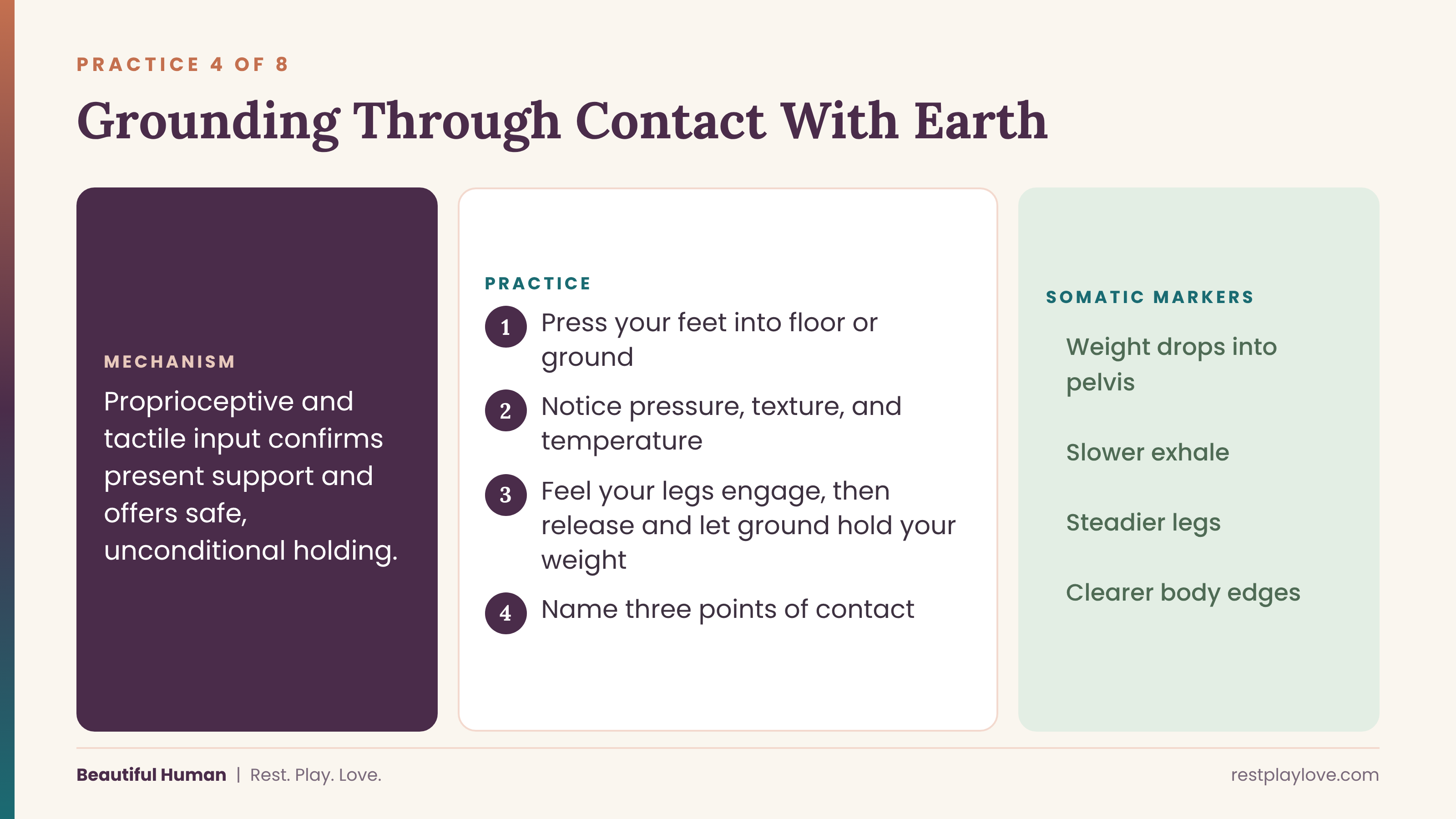
4. Grounding Through Contact With The Earth
Mechanism: Proprioceptive and tactile input from your feet and from the floor, ground, or a chair confirms present support and offers safe, unconditional holding. Your brainstem receives data that your weight is held, which lowers bracing.
Practice: Stand or sit with your feet flat. Press your feet into the ground and notice pressure, texture, and temperature. Feel your leg muscles engage, then release your push and let the ground hold your weight. Name three points of contact between your body and a supporting surface. When possible, stand barefoot on grass, soil, or wooden floors.
Somatic Markers: Weight dropping into your pelvis and legs, a slower exhale, steadier legs, or a clearer sense of where your body ends and a surface begins.
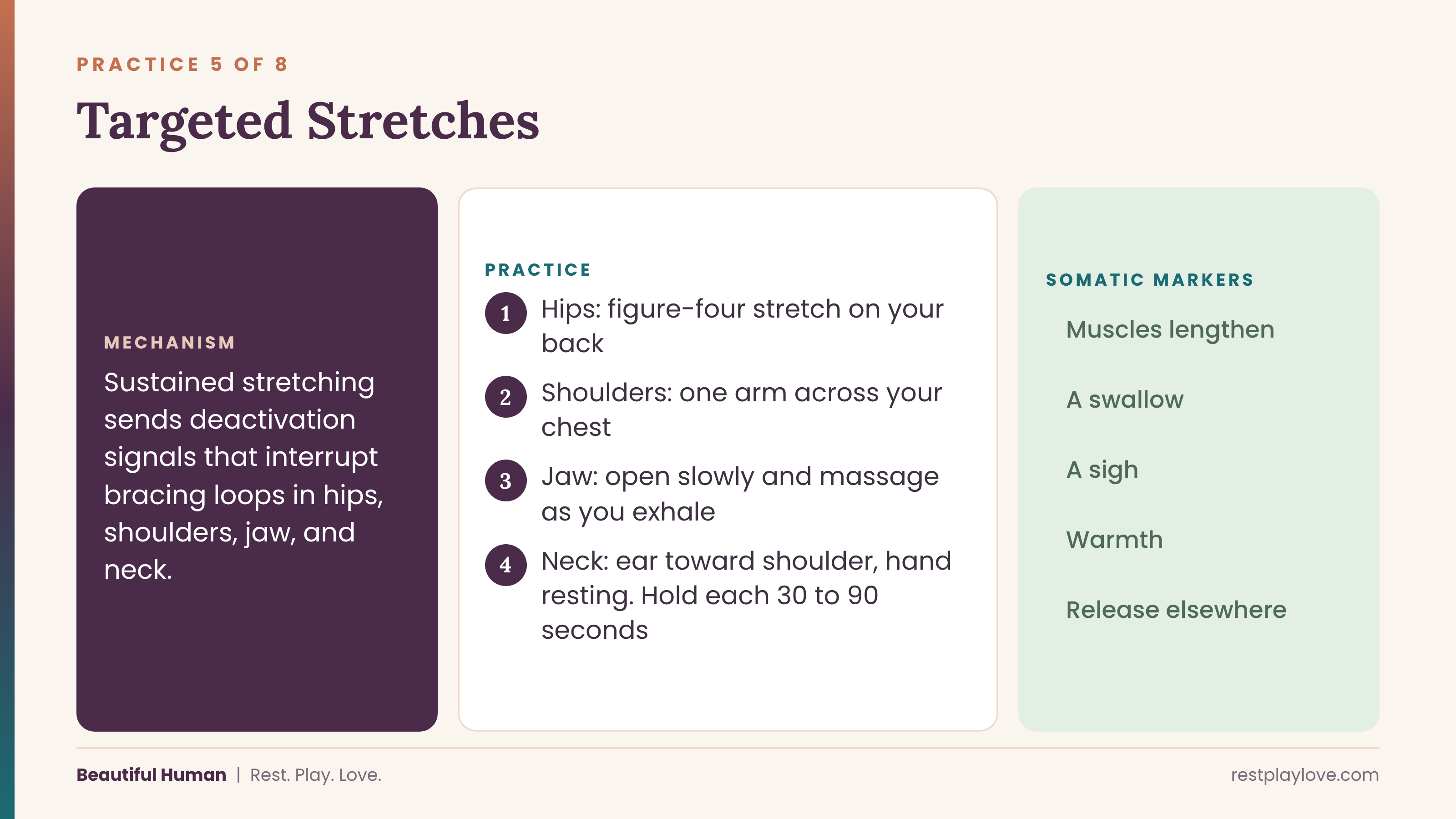
5. Targeted Stretches
Mechanism: Sustained stretching sends deactivation signals that interrupt your bracing loop. Frustration collects in your hips, shoulders, jaw, and neck, or the area of your solar plexus so stretches aimed at these areas address your body's most common frustration storage sites.
Practice: Hold each stretch for 30 to 90 seconds with slow breathing and a long exhale. For hips, lie on your back and cross one ankle over opposite knee in a figure-four. For shoulders, bring one arm across your chest and hold it with your other hand. For your jaw, open your mouth slowly and massage your jaw muscles in circular motion with your fingertips as you exhale. For your neck, tilt one ear toward your shoulder and rest your hand lightly on your head, with no pulling. For your solar plexus, gently perform a back bend, like the Locust or Bridge pose in yoga, or simply lie down on a tall pillow (or two smaller pillows) and let your heart open.
Somatic Markers: Muscles lengthening, a swallow, a sigh, warmth, or a sudden release of held tension elsewhere in your body.
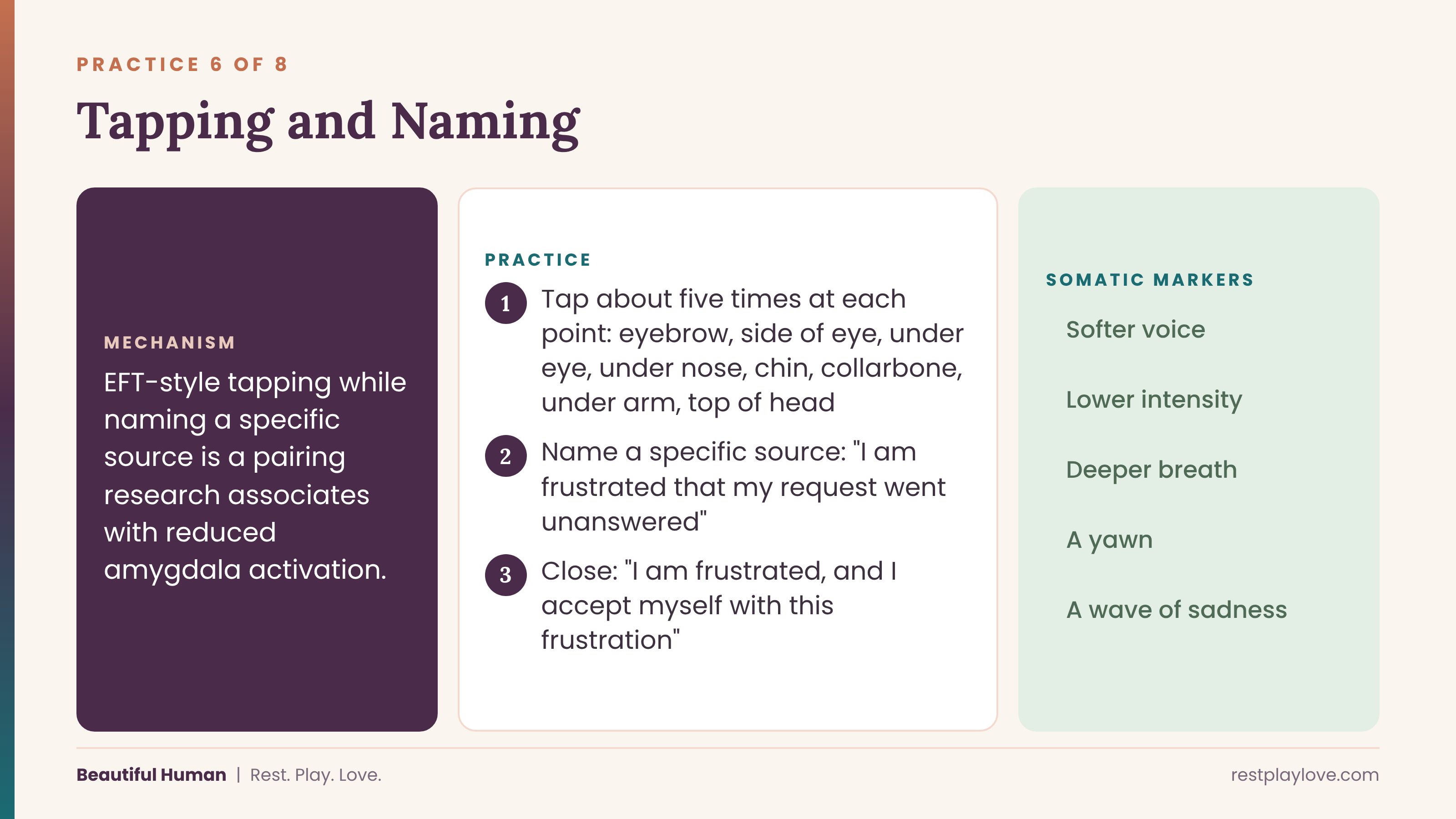
6. Tapping and Naming
Mechanism: EFT-style tapping on acupressure points while naming a specific source of frustration is a pairing that research associates with reduced amygdala activation. Naming supplies precision, and tapping supplies rhythmic tactile input that interrupts the threat response.
Practice: Using two fingertips, tap about five times on each point in this sequence: start of an eyebrow, side of an eye, beneath an eye, beneath your nose, your chin, below a collarbone, beneath an arm, and top of your head. At each point, name a specific source: "I am frustrated that my request went unanswered." Close with a statement of acceptance: "Even though I am frustrated, I completely love and accept myself and this frustration that's arising in me."
Somatic Markers: A softening in your voice, a drop in intensity, a deeper breath, a yawn, or a wave of sadness.
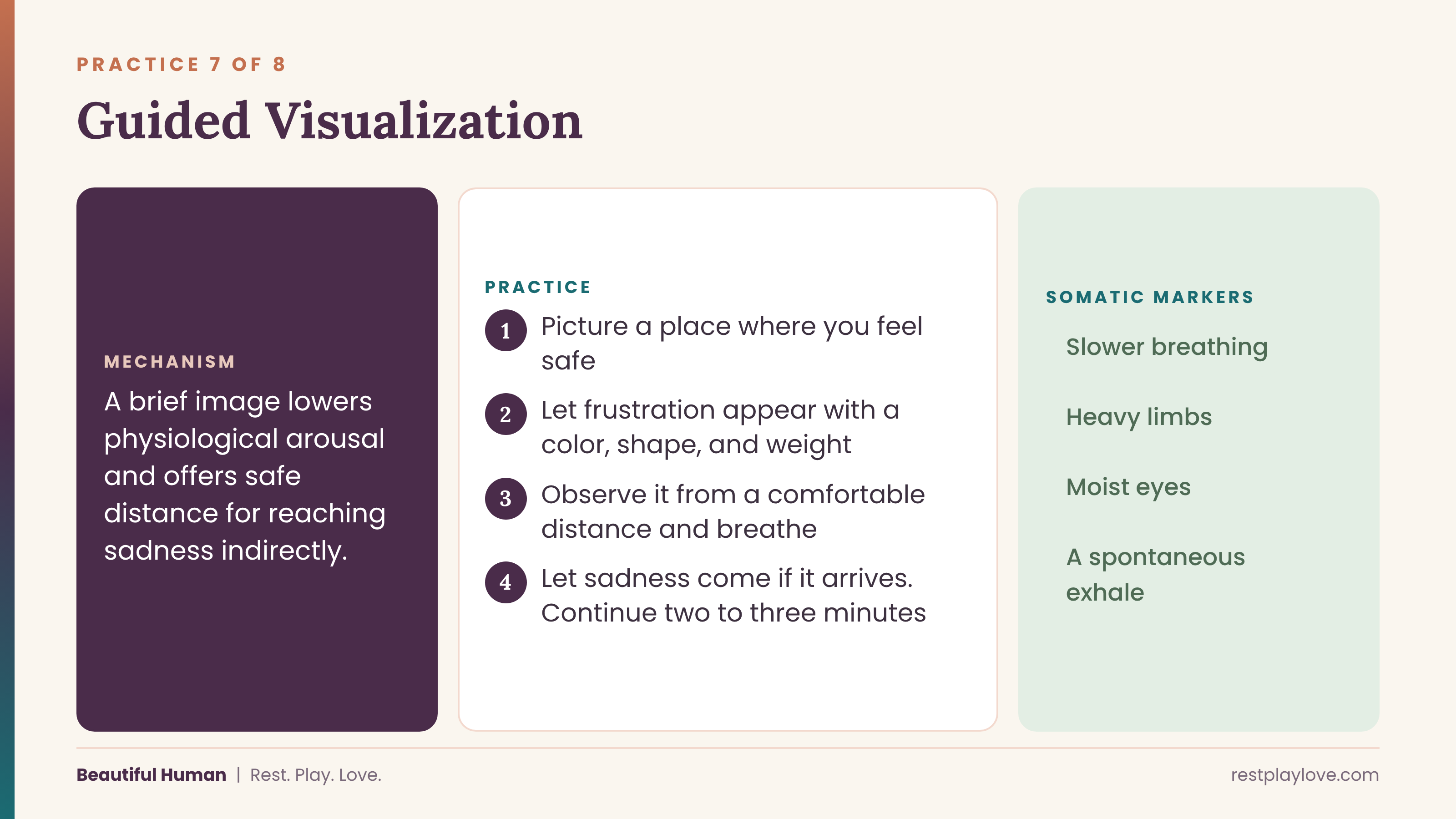
7. Guided Visualization
Mechanism: A brief image lowers physiological arousal and offers safe distance for reaching sadness indirectly, which matches how sadness is most easily approached, one step removed.
Practice: Close your eyes and picture a place where you feel safe. Once you feel settled, let frustration appear as an image in that place, with a color, a shape, and a weight, and observe it from a comfortable distance. Breathe and let your image change on its own. If sadness arrives, let it come while you stay in your safe place. Continue for two to three minutes.
Somatic Markers: Slower breathing, heaviness in your limbs, moisture in your eyes, or a spontaneous exhale.
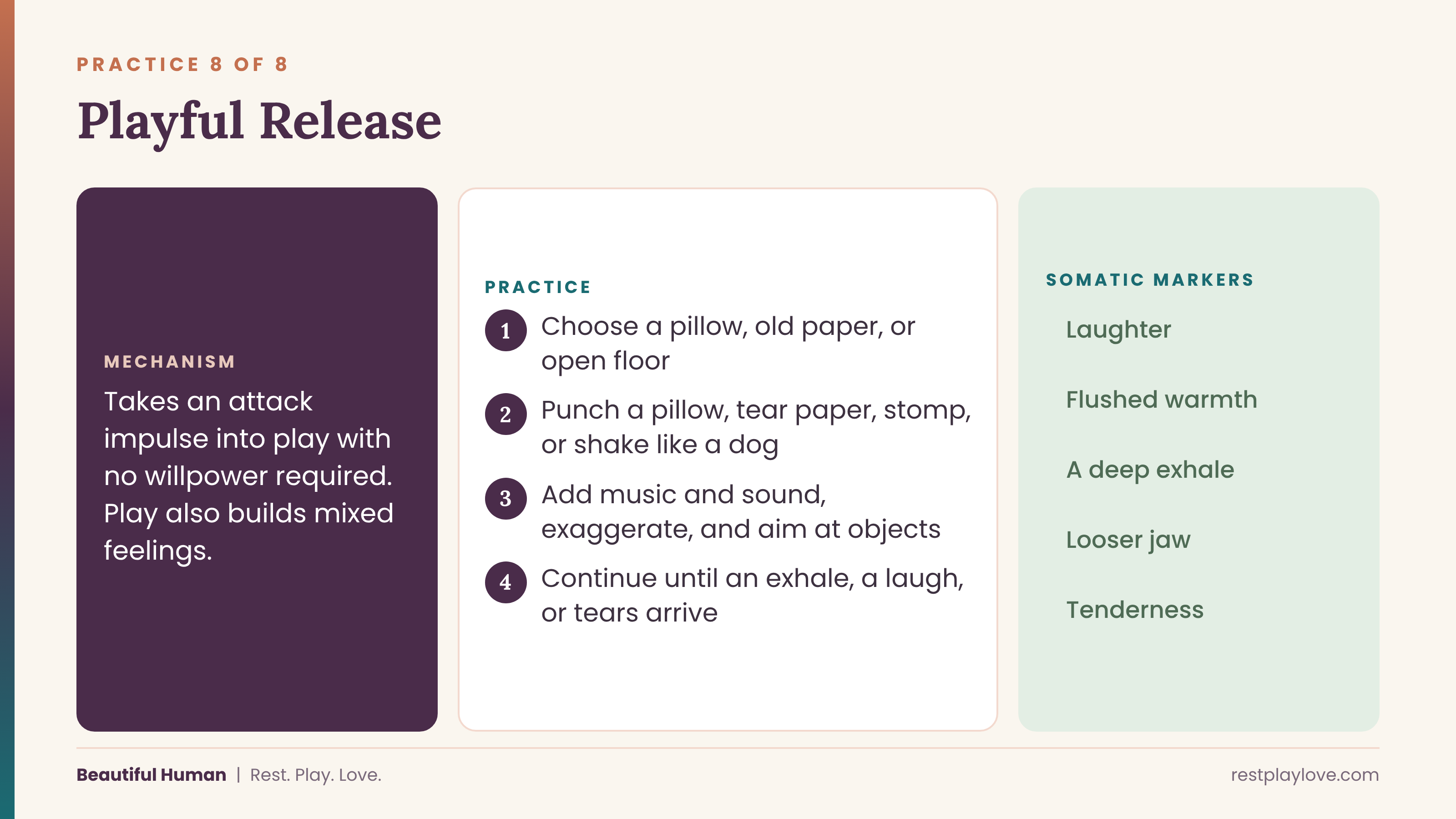
8. Playful Release
Mechanism: Playful attack and playful destruction take an attack impulse into play, with no willpower required to stop feeling it. Play also builds mixed feelings, since your prefrontal cortex develops through it.
Practice: Choose a pillow, a stack of old paper, or a patch of floor. Punch a pillow, tear paper into strips and toss them overhead, stomp like a toddler, or shake out like a dog coming out of water. Add music and sound, exaggerate your movements, and direct them at objects. Continue until you feel an exhale, a laugh, or tears.
Somatic Markers: Laughter, flushed warmth, a deep exhale, a looser jaw, or a wave of tenderness.
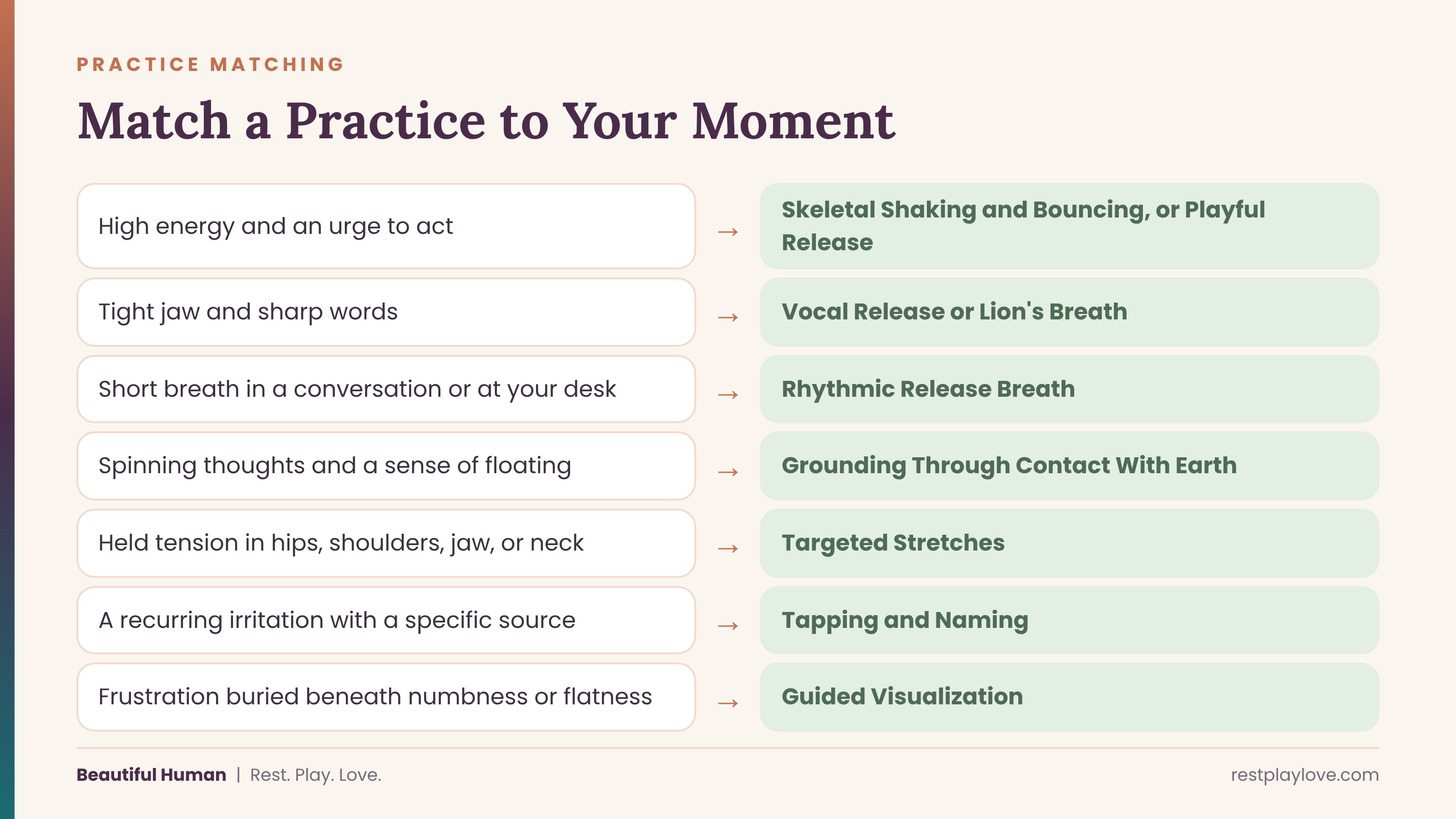
Matching a Practice to Your Moment
Frustration with high energy and an urge to act → Skeletal Shaking and Bouncing, or Playful Release
Tight jaw and sharp words → Vocal Release or Lion's Breath
Short breath in a conversation or at your desk → Rhythmic Release Breath
Spinning thoughts and a sense of floating → Grounding Through Contact With Earth
Held tension in hips, shoulders, jaw, or neck after a long day → Targeted Stretches
A recurring irritation with a specific source → Tapping and Naming
Frustration that feels buried beneath numbness or flatness → Guided Visualization
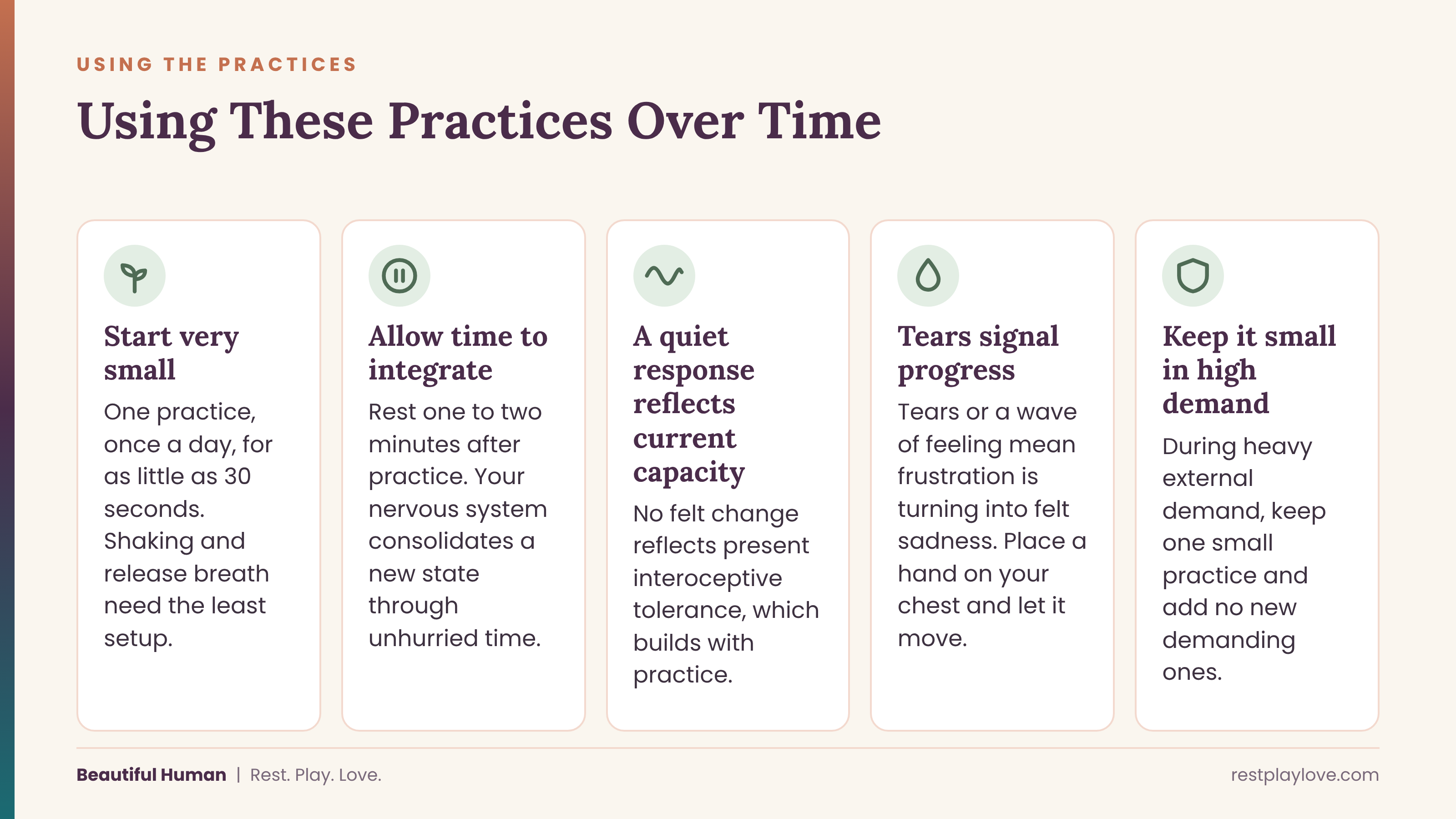
Using These Practices Over Time
Start very small. Choose one practice, once a day, for as little as 30 seconds, maybe less. Shaking and release breath need minimal setup and attention, which makes them useful starting points.
Allow time to integrate. After each practice, rest for one to two minutes without moving on to a task, and notice your body. Practice the Pause, Rest, Notice (PRN) I've discussed in prior posts, and pair it with gentle bilateral tapping stimulation. Your nervous system consolidates a new state through unhurried time after active input.
A quiet response reflects your current capacity. If you feel no change during a practice, that result reflects your present interoceptive tolerance, which is your capacity to register subtle internal change. This capacity builds with practice, and each session contributes even when sensation is faint.
Tears and waves of feeling signal progress. Tears or a wave of feeling during a practice indicate frustration turning into felt sadness, which is a shift these practices support. Place a hand on your chest, breathe slowly, and let it move. If feelings become strong, return to grounding and reach out to a safe person.
Keep practice small during high demand. In periods of heavy external demand, keep to one small practice and add no new demanding ones until you feel more capable of handling more.
Final Reflections: Frustration as a Hardworking Part of Your Nervous System
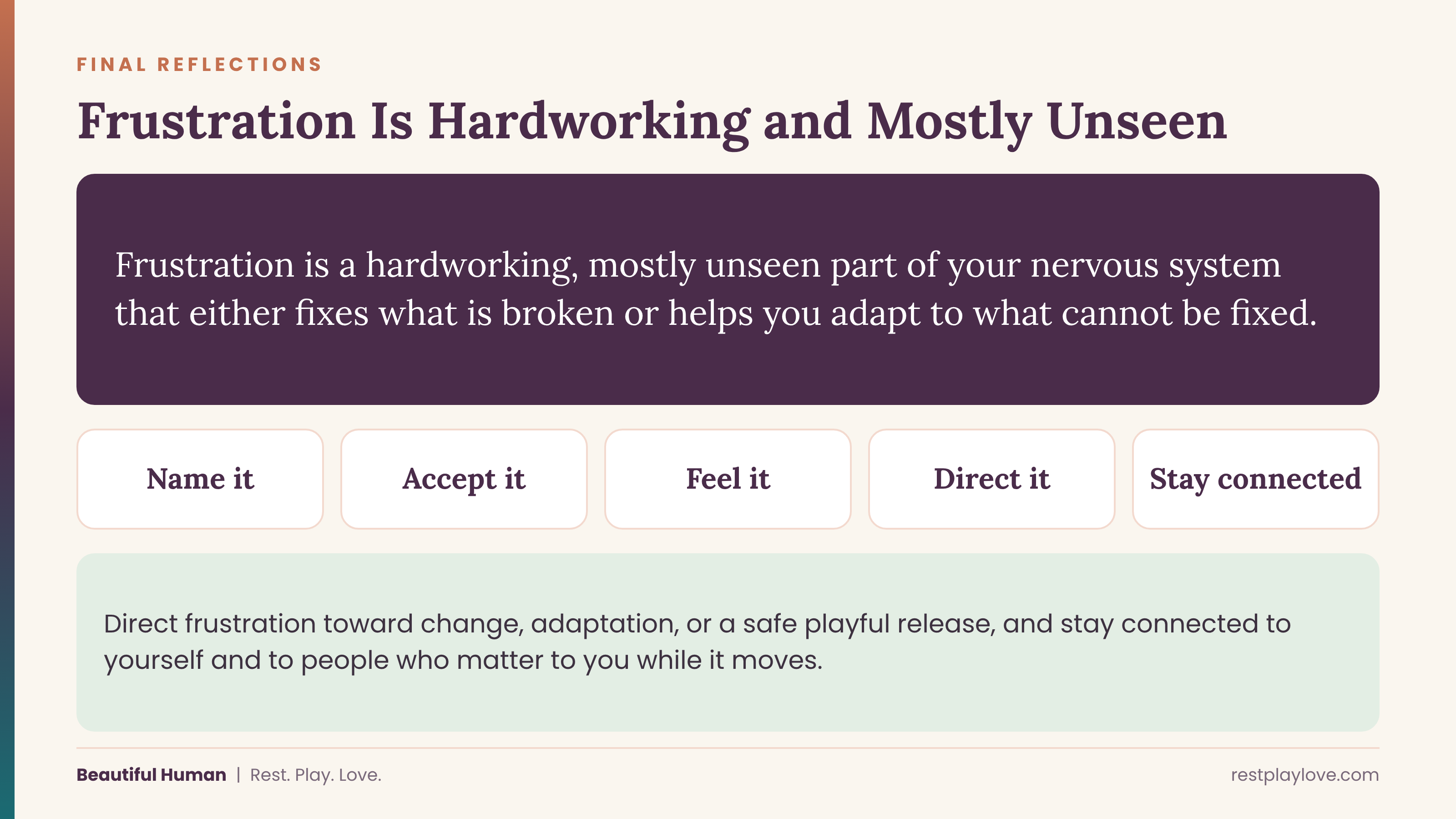
Frustration is a hardworking, mostly unseen part of your nervous system that either fixes what is broken or helps you adapt to what cannot be fixed. Judging frustration interrupts both outcomes, and releasing that judgment gives frustration room to complete its work. Neufeld's guidance comes down to a few actions you can take today: name frustration accurately, accept that it exists - which doesn't imply that you agree with it or like it, feel it in your body, direct it toward change, adaptation, or a safe playful release, and stay connected to yourself and to people who matter to you while it moves through.
Each time you do this, you add to your capacity for mixed feelings, for sadness, and for steady connection, and your frustration gains a better partner in you.
Books and Resources for Working With Frustration
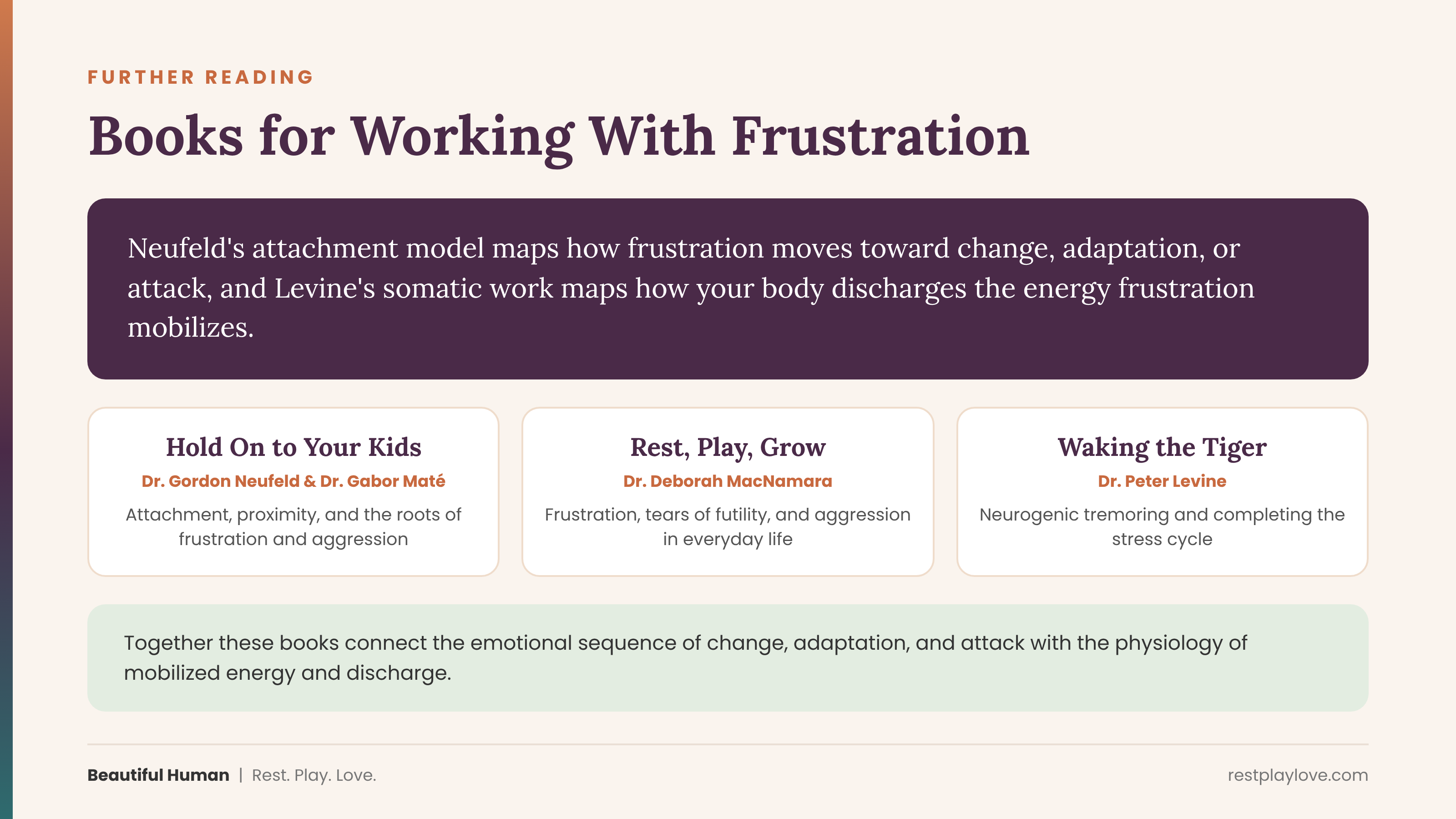
If this exploration has sparked your interest in how frustration moves through your nervous system, your relationships, and your body, here are some book recommendations that can support you in diving deeper into Neufeld's attachment-based model of emotion and into the body-based pathways that help frustration complete its cycle. Each book approaches frustration from a different angle, and together they connect the emotional sequence of change, adaptation, and attack with the physiology of mobilized energy and discharge.
Hold On to Your Kids by Dr. Gordon Neufeld and Dr. Gabor Maté. For the attachment foundation behind the traffic circle model in this post, Hold On to Your Kids lays out how attachment shapes emotional development, why our drive for proximity and connection generates so much of our frustration, and why frustration turns into aggression when attachment needs go unmet. Its greatest value lies in showing how restoring connection creates the conditions in which frustration can soften into tears and adaptation, and its insights apply to adult relationships as fully as they apply to parenting.
Rest, Play, Grow by Dr. Deborah MacNamara. For a practical application of Neufeld's model in everyday life, Rest, Play, Grow by Dr. Deborah MacNamara, a longtime faculty member of the Neufeld Institute, translates the emotional sequence of frustration, tears of futility, and aggression into accessible language and concrete examples. Although written for parents of young children, its subtitle, Making Sense of Preschoolers (Or Anyone Who Acts Like One), makes it a valuable read for adults recognizing their own frustration patterns, and its emphasis on rest and play mirrors the role of play as a sanctuary for feelings described earlier in this post.
Waking the Tiger by Peter Levine. For the physiological reasoning behind Skeletal Shaking and Bouncing in Practice 1, Waking the Tiger by Peter Levine introduces Somatic Experiencing and the observation that animals discharge the mobilized energy of a survival response through involuntary shaking, while humans often override or suppress that same discharge. This bound, undischarged energy is the same energy that keeps frustration stored in your hips, shoulders, jaw, and neck, and Levine offers a deeply practical roadmap for allowing your body to complete the cycle.
Additional Tools for Releasing Frustration Through Your Body
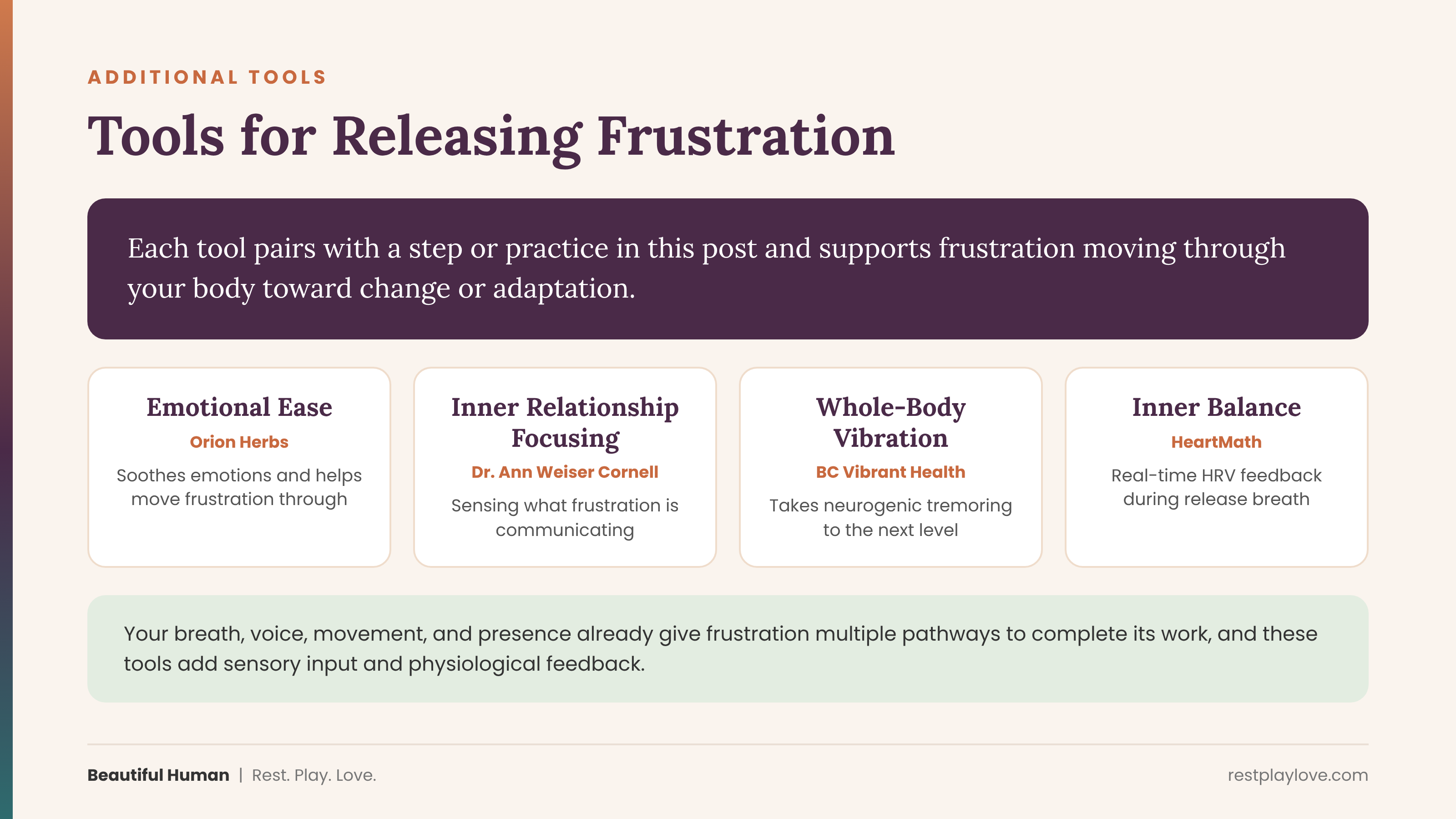
In addition to books, the tools below support frustration moving through your body toward change or adaptation, and each one connects to a step or practice described earlier in this post, giving you an opportunity to experience the release directly.
Emotional Ease from Orion Herbs is an alcohol-free herbal formula I recommend to help soothe emotions and move frustration through, particularly on days when frustration has built up and your system needs extra support settling enough to feel what's underneath it. Pairing it with Rhythmic Release Breath or Grounding Through Contact With The Earth gives your nervous system two complementary forms of support as mad moves toward sad. Explore Emotional Ease from Orion Herbs.
Finding the Gift in Anger Without Losing Your Head with Dr. Ann Weiser Cornell is a 90-minute on-demand seminar from Focusing Resources that applies Inner Relationship Focusing to anger and frustration, offering a safe and comprehensive way to release frustration by sensing it in your body and listening to what it's communicating. Ann is the developer of Inner Relationship Focusing and one of my most cherished teachers, and her approach uses the same presence language introduced in Step 1, "Something in me feels frustrated," to help you come alongside frustration while it reveals the felt meaning underneath, which is the specificity Neufeld describes when he calls feelings the eyes of frustration.
For those who want to take the shaking and bouncing in Practice 1 to the next level, the whole-body vibration plates developed by Becky Chambers of BC Vibrant Health produce rapid, involuntary muscle contractions through the tonic vibration reflex, supporting neurogenic tremoring and the discharge of mobilized energy through your legs, hips, and torso with minimal effort on your part. Whole-body vibration also offers additional benefits, including support for circulation, muscle strength, and bone density. My two favorite options are the Ultimate Vibe, which offers a gentler starting point for people who are more sensitive to stimulation or want to begin conservatively, and the Vibrant Health Power 1000, which provides a larger platform and stronger vibration for people who are relatively active. Apply discount code AlessaD10 at checkout to receive 10% off, and take advantage of Becky's free personal consultation at 877-422-8423 or 781-879-9857 to determine which machine and vibration level is the most appropriate place for you to begin.
HeartMath Inner Balance provides real-time heart-rate variability feedback while you practice Rhythmic Release Breath, letting you watch your heart rhythm move from the erratic pattern associated with frustration toward a smoother, more coherent rhythm as your exhale lengthens and your cardiac vagal tone increases. Seeing that shift helps your brain connect the practice with the relief it provides, which motivates you to return to it the next time frustration builds. Explore HeartMath Inner Balance.
All of that said, while they can and will certainly help, you don't always need books or equipment to begin releasing frustration. Your breath, your voice, your movement, your capacity to name what you feel, and your willingness to stay with yourself already give frustration multiple pathways to complete its work. These resources offer additional education, sensory input, and physiological feedback for those who want to explore further or who have been carrying frustration and judgment of frustration for a long time.
This section contains affiliate links. I only share books, protocols, and tools that I've personally integrated and found meaningful enough to include in my personal and professional work and writing. If you choose to purchase through one of my affiliate links, I may receive a small commission at no additional cost to you.
Keep Building Your Practice With Me: Free Practices and Ongoing Support for Releasing Frustration
Guided Practices: Free guided meditations and somatic practices, including shaking, release breath, grounding, and much more are available on YouTube at @Dexterandalessandrina.
Daily Regulation Support: Follow me on Instagram at @beautifulhumanhealing for short practices and insights on releasing frustration and building emotional resilience.
Deeper Work: Explore personalized support for working with frustration, emotional release, and nervous system regulation through my Gentle Offerings.
Alessandrina Dorer
